Patients, Patience, and Impatience

Hello, again, Folks,

Today, I speak of a peculiar paradox of somatic education — something expressed in a Tibetan saying I heard, recently:  “When things are urgent, go slower.”

People in pain have a certain urgency.  No surprise.

In their urgency, they go for the “quick fix” — the pain med, the quick adjustment, the quick stretch, the hour of bodywork.  These quick fixes rarely produce either a complete or a lasting result.

The reason:  they don’t address the problem as it is, but only the surface appearance.

Somatic education is peculiar in this regard:  the processes we use during clinical sessions are mostly slow-motion action patterns — we go slower — but the changes that result come very quickly.

The reason:  the changes sought through somatic education (generally, pain relief) come by means of an internalized learning process that involves new physiological adaptation.  Adaptation and learning require, inevitably, at least two things:  attention and intention.

Attention and intention go together.  To exercise an intention, we must direct our attention to what we are doing.

The thing about attention is that it is not instantaneous; it fades in.  Test for yourself.  Look away from the screen toward anything and notice that it takes a good part of a second even to focus on it.  The same is true of music.  Turn on the radio into the middle of a piece of music and notice that it takes some seconds to recognize even one with which you are familiar.

When taking in new information, going slower helps you “catch” it and take it in.

Then, and only then, you can apply your intention to it.

Most forms of therapy require little or no attention on the part of a patient; result:  little or no exercise of intention and little or no lasting change!

So, as a somatic educator, I find that one of the most common bits of coaching I have to give with my clients (/patients, although I don’t use the word) is to slow down.  Doing things too fast, too hard, and with too little attention (“mindfulness”) is a common American fault (and a popular editing technique of advertising and the entertainment media which perpetuates and reinforces this fault– sequences of “split-second video clips”).  Too many people are “A-D-D” ! ! !  That makes them accident-prone (and generally, sloppy and error prone).  They must slow down — not because it’s easier (generally, it’s not), not because they need a rest (which is generally true), but because they need to pay more attention and to exercise intention more carefully.  They need to work smarter, not harder.

If people don’t slow down, they end up doing things the way they habitually do them and, by repetition, reinforcing the very thing they are wanting to get out of — the movement patterns and functional habits that cause their pain.  They have to slow down enough to do the things they do in a new way.

When it comes to somatic exercises (a way people can relieve their own pain without direct coaching by a somatic educator), people must exercise patience.  In this case, the patience they must exercise is two-fold:  (1) they must slow down in what they’re doing (somatic exercises) enough to feel clearly what they are doing and to do it in good form (not merely count repetitions) and (2) they must persist in a somatic exercise program long enough to obtain its designed-in effect (entailing, generally, some days or weeks of practice — and some hours of experience).  The result:  substantial and durable improvement — faster and more durable than by conventional therapeutic, “low-attention” methods.

If patients are impatient for relief, they must be patient so they can get it more quickly than has previously been possible.

Only once they have slowed down and made the necessary changes can they return to “the speed of life” and keep their new-found freedom and well-being — or even go faster than before and still keep it together.

“A man of true means,
whatever the day’s pace
keeps his wits about him
and however a fine offer be presented to him
keeps a level head.

What ruler of countless chariots
would make himself laughing stock,
fool of the realm,
with pace beyond rein,
speed beyond helm?”
— Lao Tzu

SEE MORE ABOUT SOMATIC EXERCISES
An Entirely New Class of Therapeutic Exercises (article)
Software for Your Body (instructional programs)

Add your comment — what you would like to ask or tell.

Palpation — One of a Somatic Educator’s Essential Techniques

Thomas Hanna said that palpation — gathering information by touch — is a lost art among medical professionals, and that we, his students, would become masters of it.

In the process of Hanna somatic education, palpation isn’t just done at the initial functional assessment of a client’s condition, nor is it only an information-gathering action.  It’s properly done at every stage of a clinical session of Hanna somatic education to evaluate the results of each pandiculation, and it provides information not only to the practitioner, but also to the client about his or her current condition.  How else are we to know whether we are finished with a region and its movements?

In a previous writing, “Precision Positioning for Miraculous Results“, I speak of this last point in some detail.

For now, I want to communicate some things about the art of palpation, itself.

PALPATION IS A FOUR-DIMENSIONAL ACT
Now, before you go bounding off screaming, “another New Age twinko!!!”, I want to clarify.  The fourth dimension, time, is not a Twilight Zone alternate reality or a mysterious abstraction (as implied by the term, “time-travel”).  It’s motion, itself, in the most ordinary sense.

We measure time by means of devices that move or display regular changes (watches and clocks) and we experience time the same way.  The term, “second”, refers to the period of time between two heartbeats, the second heartbeat defining the end of a second.  It’s an approximate term, the way the length of a foot is about one foot and the length of the first segment of the thumb is about one inch and one swallow is about once ounce.  Time is motion.

In palpation, many people touch surfaces with their fingertips and think they are palpating.  When such a technique provides little useful information, they abandon palpation as an investigatory act.  It’s not a shortcoming of palpation; it’s a shortcoming of their technique and their understanding.

To do a decent palpation that actually provides useful information, you’ve got to feel, not for a surface, but for a volume — three (3) dimensions.  And you don’t go rushing in, do a couple of quick presses, and move out.  What you do is soften your hands, reach in, and feel for the first resistance for reaching more deeply; you feel for where soft space becomes firm contact.  You go in slowly — both out of respect for your client and for rich information.  Then, you wrap your hands around what you feel to discern its shape.  If you’re squeamish, palpate in yourself until you learn the lay of the land and what it might feel like to your clients.

If you want to get more out of palpation, trace muscles from origin to insertion; that gives you something on which to anchor your attention and gives your client new sensory information that tells them in which direction, along what lines, to contract in pandiculation.

Once your client has done the pandiculation, or after you have done Kinetic Mirroring, you use palpation and movement to evaluate the completeness of the result.  If some sensory-motor amnesia — and muscular contraction — remains, you either repeat the process or have your client adjust positions to reach what’s left.  Palpate — Pandiculate — Palpate.  Continue until the involuntary tendency to contract is gone or it ceases to decrease, then move on.

Add your comment — what you would like to ask or tell.

Understanding SacroIliac Joint Pain, Stopping the Pain and Weird Symptoms

This article is about sacroiliac joint dysfunction, also called, sacroileitis, sacral torsion, turned sacrum, sprained S-I joint, sacroiliac joint syndrome, and sacroiliac (S-I) joint pain.

It explains what you need to correct it and it contrasts the correction-approach presented, here, with other forms of treatment in a way that I expect will make sense of them, to you.

It also lists symptoms and contains a link to an article with a more complete list of symptoms and explanations of their causes (that trace back to a turned sacrum).

You can read a more technically complete article, here.

images of pelvis and sacroiliac joints

It may see odd, to you, that many of the symptoms you have — pain in places seemingly unrelated to your sacroiliac joints — come from a turned sacrum.

At the same time, many of these pains are medically un-diagnosable — meaning, no medical explanation can be given for many of them — or the explanations given were educated guesses and the therapy didn’t work. If you’ve had extended therapy for those pains, and therapy for those mysterious pains didn’t help, or didn’t help enough, or didn’t produce lasting relief (common), they weren’t understood or approached, correctly, by the methods used.

WHO IS THIS ARTICLE FOR? 
This article is for you if . . .

  • you have found the information provided on sacroiliac joint pain, both by medical practitioners and “alternative” medical practitioners, to be “thin soup” that doesn’t make you feel particularly optimistic about your recovery from sacroiliac joint dysfunction and doesn’t increase your understanding, much, but only leaves you feeling faintly hopeful — hope perhaps tinged with desperation or despair.
  • you have found pain medications inadequate to deal with the pain.
  • you have tried therapies and/or surgery and are still in pain.
  • you won’t settle for less than lasting relief and are willing to do the work to get it.

WHAT’S IN THIS ARTICLE?

  • symptoms of sacroiliac joint dysfunction
  • explanation of what healthy sacroiliac joints do
  • what happens to your sacrum that causes sacroiliac joint dysfunction
  • a comparison of not-so-successful and highly-successful ways of clearing up sacroiliac joint dysfunction
  • a detailed explanation of how clinical somatic education clears up sacroiliac joint dysfunction
  • a way to get started correcting the condition and ending the pain (CLICK, HERE)

The Simple Explanation of Sacroiliac Joint Syndrome (Dysfunction)

“If you can’t explain it simply, you don’t understand it.”
Richard P. Feynman


Sacroiliac joint dysfunction (SIJD) comes from displacement (misalignment) of the bones of the pelvis and strain at the ligaments that bind the joints together.  

Of the symptoms of SIJD, pain at a sacroiliac joint (at waistline level, in back, two to three inches to one side) combined with groin pain is the most common. I list other frequent symptoms, below.

SYMPTOMS OF S-I JOINT PAIN SYNDROME
Sacroiliac Joint Dysfunction

Following are the most common symptoms of sacroiliac joint dysfunction. Many more exist that vary from individual to individual.

  • pain at the groin and waistline, in back, same side – in combination
  • pain around the top rim of the pelvis
  • deep buttock pain, one side
  • reduced ability either to bend forward or to stand up straight

On another page, I list more symptoms grouped by:

  • SENSATIONS
  • SKELETAL ALIGNMENT CHANGES
  • MUSCLE/MOVEMENT MEMORY CHANGES
  • EMOTIONAL EFFECTS
CLICK HERE TO VIEW OTHER SYMPTOMS.

There are a lot more symptoms listed on the VIEW OTHER SYMPTOMS page

If you have two or more of the symptoms listed on this page, you likely have sacroiliac joint dysfunction.

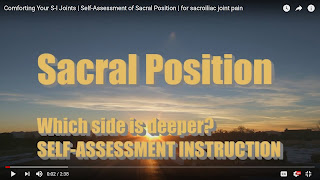
But don’t assume that, from the symptoms. Other conditions can cause many of the same symptoms. Symptoms only suggest where to look for the cause. The way to tell if you have SIJD is by manual examination of your sacroiliac joints — something you can do, by yourself, as instructed in the video, below, SELF-ASSESSMENT OF SACRAL POSITION. If you find one side deeper, that’s it: a twisted sacrum and S-I joint strain.

Follow the instructions. Self-examination involves a simple movement with your hands to feel the region of your S-I joints. Pay close attention to the spoken instructions so you know what you’re feeling for. Don’t guess. Either you can feel it, or you can’t. 

SELF-ASSESSMENT OF SACRAL POSITION
https://youtu.be/5zB1T6fYPLA

By feeling the region of your back described in the video, you can feel ridges on both sides with your fingertips. These are not the S-I joints, but the edges of the neighboring hip bones. Toward the midline (the spinal line), next to those ridges, you feel, and others may see, dimples. Your S-I joints are there. The dimples are easier to find in some
people than in others, but the S-I joints are there, deep to the dimples.

If you can’t tell, you may visit a chiropractor or osteopath to get a diagnosis and to get trained how to examine yourself. If you’re going to use the program of exercises to correct your own SIJD, you’ll need to be able to examine yourself before each exercise practice session to know which side to do.

If you’ve found one side sacroiliac joint deeper(“jammed”), you know what’s going on with you. Good for you. Now, you know what you need: a way to straighten out your sacrum so it stays straightened out. That’s on this page, at bottom.

If neither side S-I joint seems deeper, your symptoms may come from other
injuries — which is good news for you because other injuries are much
easier to clear up than SIJD. Visit the Consultation page to get a free Functional Assessment form. Complete it and return it to me by email for a recommendation.

Causes of a Turned Sacrum

THE SACRO-ILIAC (S-I) JOINT LIGAMENTS ARE NOT THE CAUSE OF S-I JOINT DYSFUNCTION, BUT THE VICTIM OF IT — and the side that hurts is the non-jammed side (contrary to what one might expect).

This Mayo Clinic entry describes recognized causes of a twisted sacrum.

Sacroileitis — Comprehensive overview covers symptoms, causes, diagnosis, treatment of inflammation of the sacroiliac joints. 

ref: Overview – Sacroiliitis – Mayo Clinic

Causes for sacroiliac joint dysfunction include:

  • Traumatic injury. A sudden impact, such as a motor vehicle accident or a fall, can damage your sacroiliac joints.
  • Arthritis.
    Wear-and-tear arthritis (osteoarthritis) can occur in sacroiliac
    joints, as can ankylosing spondylitis — a type of inflammatory arthritis
    that affects the spine.
  • Pregnancy. The
    sacroiliac joints must loosen and stretch to accommodate childbirth. The
    added weight and altered gait during pregnancy can cause additional
    stress on these joints and can lead to abnormal wear.
  • Infection. In rare cases, the sacroiliac joint can become infected.

In my clients’ experience, nearly all cases come from an injury, with far fewer from pregnancy or other causes. Injuries include falls (bicycle, horse, rooftop, skating, ladder, etc.) and motor vehicle accidents with one foot on the brake at the moment of impact jamming the leg into the hip on one side.

Unsuccessful and Successful Ways to Extinguish S-I Joint Pain

Not-So-Successful Approaches

You may be familiar with these approaches.

Two surgical measures used to stop S-I joint pain are radio frequency nerve ablation (“RFA” – cooking the nerve ending) and Sacro-Iliac Joint Fusion.

  • Nerve ablation costs about $2,100 and lasts 9-12 months before the nerve regenerates — making repetition necessary.
  • Sacro-Iliac Joint Fusion surgery costs about $22,000 and has the side effects detailed in the article just below. Neither corrects the problem, but only minimizes symptoms.

Click the image, below, to read the article by Dr. Centeno.

Click for this article by Dr. Centeno.


Skeletal manipulation is another approach. However, because of the muscle spasms triggered by a twisted sacrum, adjustments to the sacrum don’t “take”. Distorted muscular pulls distort the weight-bearing forces that go through the pelvis and distort its shape. Symptoms return or never  go away.

https://youtu.be/K7urk1N5hPU
The Three Biggest Mistakes Made by People
Trying to Get Out of Pain


Two other approaches have to do with the ligaments that bind the S-I joints — and they’re opposites.

  1. Loosen the ligaments by direct massaging or manipulation. 
  2. Tighten the ligaments by prolotherapy.

If it strikes you as odd that practitioners use two opposite approaches (and not together), it suggests to me that their approaches are “shot in the dark” efforts in terms of something they know about. Certainly, if they were consistently effective, SIJD would not be considered so difficult to clear up.

But the ligaments are not the cause, but the victims of the twisted sacrum, and I’ve quoted the Mayo Clinic article as to causes. Any successful approach should somehow address the condition in terms of its cause, don’t you think?

Another approach, the approach I took and advocate, has no negative side effects, consistently provides lasting relief, and restores full function. I explain it, next.

Clinical Somatic Education

Because the field of clinical somatic education is relatively new and not well-known, I’ll briefly explain it, to you. You may see this page, for more explanation.

Clinical somatic education is a health discipline used to extinguish pain and improve movement. Muscles relax, nerve pain ends, and joints come loose. Instead of stretching, we use a completely different technique that causes a long-lasting relaxation of tight muscles by changing muscular control at the brain-level. It’s called, pandiculation.

Pandiculation: “The Whole-Body Yawn”

Pandiculation is an action pattern related to yawning that has far-reaching effects on muscular control and physical comfort. It’s ideally suited for retraining
muscle/movement memory. Pandiculation is a completely different technique from stretching or manipulation.

DOES STRETCHING “ONE BETTER”

Everyone has experienced pandiculation. The “morning yawn and
stretch” is a pandiculation (but the athletic, warm-up stretch is not, by the way).

Pandiculation is what cats, dogs, and every animal with a backbone does, upon arising
from rest. People call it, “stretching”, but it isn’t stretching; it’s tightening muscles and then slowly relaxing and moving or even shaking (you’ve seen a dog do this movement). Pandiculation can be done in more ways than just yawning or the morning “waking up” stretch.

Pandiculation is essential to reprogram muscles and movement. You need to unlock
something before you can adjust it. Pandiculation unlocks muscle/movement memory, so it can be changed.

My earlier description of the causes of SIJD cites muscular involvement and distortion of pelvic shape. The two go together, as I have explained — but, to put it more succinctly, “Bones go where muscles pull them.” Clinical somatic education addresses the muscular involvement and skeletal alignment.

The system of somatic education exercises I developed to correct my own SIJD uses patterned movements to retrain muscle/movement memory. Changes of muscular pulls cause the pelvis to reshape. These changes can clearly be felt. Again, “bones go where muscles pull them.”

Click on the image, below, to see the entire comment.

screen shot of testimonal by Michelle Knight
 

TO SUMMARIZE:

Compression and twisting forces that converge at the S-I joints cause compression of the S-I joints, strain the S-I ligaments, trigger reflexive muscular contractions throughout the trunk and legs that cause muscle and cause radiating nerve pain (that may be mistaken for spasm) — symptoms that never let up, day or night.

S-I Joint Dysfunction or Sacroiliac Pain Syndrome (the word, “syndrome ” meaning a recognizable cluster of symptoms) comprise a complex collection of symptoms that doesn’t respond to therapy, when addressed directly. The key to stopping the pain is to get the position of the sacrum to straighten.

ACTIONABLE UNDERSTANDING

By now, we can see how the forces of an injury initially distorted the pelvis and how muscular contractions, maintained by muscle/movement memory, have kept the problem in place

That means that we can’t correct the problem in any lasting way by addressing the ligaments. (To tighten the ligaments, as in prolotherapy, misses the point and to stretch or loosen the ligaments may reduce their strain, but doesn’t correct pelvic shape or habituated muscular tension patterns).

It also means that we can’t massage away the problem (have you noticed?). It means that we have to free the person from the grip of cringe response and develop balanced, well-coordinated movement that supports the sacrum properly and induces the pelvis to become symmetrical (“mirror-image the same shape”, right-and-left).

Clinical Somatic Education to Correct Sacroiliac Joint Dysfunction:
The Role of Movement (“muscle”) Memory

The medical model, which uses drugs, surgery, and electrical or mechanical devices, generally targets a specific symptom or location of pain, but does not, typically, address muscle/movement memory — even if it does address skeletal alignment, as in chiropractic or osteopathy. Moreover, the medical specialty, “pain management”, is a branch of anaesthesiology; it’s primary approach is to mask or hide pain, not to eliminate its cause.

Unlike the medical model and standard therapeutics, clinical somatic education uses action (movement) patterns not to stretch, but to free — and then re-pattern — the muscular tensions that cause the pain of S-I joint dysfunction and keep the condition in place.

The key term, here, is, “patterns”. Thomas Hanna, in his book, Somatics | ReAwakening the Mind’s Control of Movement, Flexibility and Health (available at many public libraries and via amazon.com), talks about how those tension patterns form with an injury and the process of ending them and their symptoms.

These changes of muscular tension pattern influence pelvic shape over the long term. It’s an entirely new, brain-muscle-based approach that works without need for stretching, strengthening, or soft-tissue manipulation. Instead, it corrects muscle/movement memory, and thereby gets all of the effects of strengthening, stretching, and soft-tissue manipulation — but in a lasting way.

Somatic education causes no undesirable side-effects, other than occasional, short-term soreness immediately after a practice session and lasting 1-2 hours, or 24-36 hours after a practice session, lasting about as long.


ComfortingYour S-I Joints.

With clinical somatic education, we correct S-I Joint Dysfunction in three stages.

  1. Unlock the Situation. We reduce the tension levels of the involved muscles, sufficiently to unjam the jammed S-I joint to permit repatterning of the forces that keep the pelvis distorted. 
  2. Reshape muscular tension and movement patterns through practice of movement patterns consistent with a sound, symmetrical pelvis and healthy S-I joint function. 
  3. Reinforce healthy, free, balanced patterns of movement — not by strengthening, but by developing better integrated movement habits. These movement habits become second nature and do not require special attention in daily life.
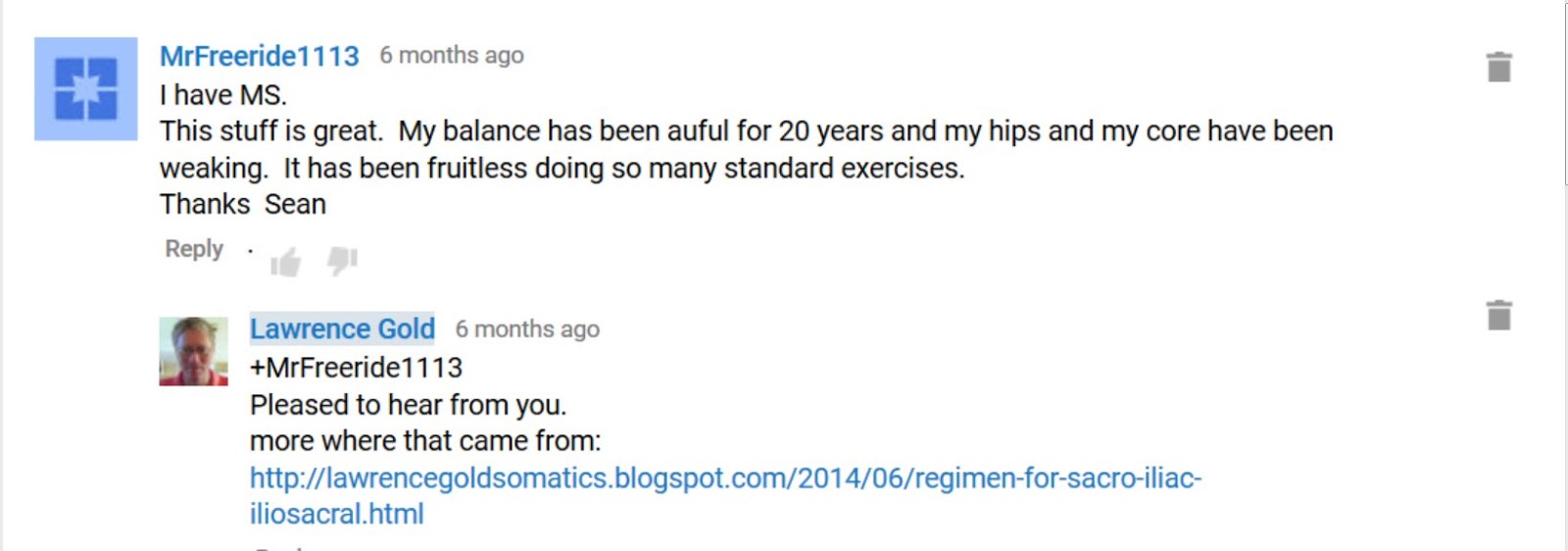
screen shot of testimonal comment from YouTube video


Click on the image, above, to see entire comment.

See the section, below, to get started with Comforting Your S-I Joints, for free. It’s free because I expect you to find it effective and to purchase the rest of the program.


Comforting Your S-I Joints | A RECIPE for RELIEF

This self-renewal program been well-tested — starting with myself as the first “guinea pig”.  (Remember, I am a trained practitioner of a health discipline to eliminate pain and rehabilitate movement.)  I had most of the symptoms listed. Once I found the exercises worked in me, I published them as preliminary instructional videos and then started teaching them to clients.

I understand why someone might be very cautious about taking an alternate approach to clearing up the problem — and I suspect that you may already have “been the route” with both medical and “complementary medicine” practitioners, to little avail. What I can say is that no one has gotten worse, from this approach, and an overwhelming percentage have gotten better. Everyone I have worked with, personally (I’m a clinical somatic educator practicing since 1990), has been satisfied with the result.

The program consists of a series of somatic education exercises that retrain movement (muscle) memory, done in a specific order.

As in a cake recipe, no one ingredient constitutes the entire recipe, and there are steps of preparation; a somatic education exercise may be viewed as an ingredient and the whole program is the recipe.

Who is This Program For?


The “Gentle Spine Waves exercise” in Unit 1 of the program is such an ingredient and a step of preparation. It’s not expected to relieve your S-I symptoms, by itself (although it works for simple back pain); it’s a necessary step to unlock the situation. What it does is relax the back muscles; this step is one of preparation, not of “cure”.


https://youtu.be/-JMk0ANH7c8

HOW TO UNLOCK THE SITUATION:

Unit 1 of Comforting Your S-I Joints is the foundation of the program. Called, “Unlocking the Situation”, it decompresses a jammed S-I joint so that the sacrum can be caused to move by the exercises in Unit 2. You do Unit 1 before every practice session of Unit 2 exercises. Scroll to the bottom to send for instructions to get started for free.

By getting started with Unit 1, you can develop the confidence that you actually can succeed at this program and, as improbable as it may seem, do for yourself what medical professionals and therapists have been unable to do, for you. Structured exercises that retrain muscle/movement memory can do for you what manipulation, drugs, TENS (“transcutaneous electrical nerve stimulation” — nerve stimulation through the skin), or surgery, cannot.

After the unlocking, exercises that use pandiculation accelerate changes of muscular (postural) habits. The pelvis starts to reshape and the sacrum, to migrate to a new, comfortable position. With practice, improvements accumulate.

Once the changes have occurred, pandiculation exercises reinforce the new pattern. Job done.

If you’re used to exercises or therapies that produce such small changes that you can hardly tell if anything is different, this isn’t that. With somatic education exercises, you can feel changes rather quickly (obvious after two practice sessions). As, your movement and posture change, the symptoms of SIJD fade out.

TO GET STARTED, at no charge

To get started with Comforting Your S-I Joints click, here.

You will land on the Getting Started at No Charge page, which contains practice instructions and a link to purchase the entire program.
A quick-response email message will come to your email address requesting permission to mail to you. Once you give permission, “Getting Started for Free” emails will come to you with bite-size steps for Unit 1 of Comforting Your S-I Joints.Comforting Your S-I Joints is a system of movement-based action patterns that reprograms muscle/movement memory in a lasting way. You’ll feel changes for the better with each practice session; changes accumulate over time. The entire system extinguishes the pain and restores mobility.

Final words: These exercises are refreshing, not tiring. If you’re feeling too tired to practice the exercises, practice them and get refreshed.

Comforting Your S-I Joints screen image

 
CLICK THE IMAGE, AT RIGHT
OR GET STARTED, FOR FREE,
BY ENTERING YOUR INFORMATION, ABOVE.
Take Advantage of the L.E.A.R.N. Advantage

Click the image, above, to find out about
availability of personal mentoring through the program
with me, Lawrence Gold.

~~ Since 1996, I have offered a Lifetime Money-Back Guarantee ~~

copyright 2014-2018 Lawrence Gold
This writing may be reproduced only in its entirety,
with accurate attribution of its authorship
and contact information.


Lawrence Gold is a clinical somatic educator trained in Hanna somatic education, a clinical modality for relief of pain, with two years experience on-staff at a community hospital rehabilitation center in California and with a world-wide clientele for his private practice. If you have chronic pain for a lingering injury, he invites you to contact him for a preliminary consultation, here. Learn more about Lawrence Gold’s background, articles published, and speaking engagements, here.
This article is republished from Full-Spectrum Somatics:
http://lawrencegoldsomatics.blogspot.com/2011/04/understanding-sacro-iliac-joints.html
Add your comment — what you would like to ask or tell.
The Somatic Codes

There is a special meaning for that term — The Somatic Codes.

It’s more akin to Morse Code than it is to the Codes of Hammurabi.  However there is virtue to it that would potentize the Codes of Hammurabi, if they were integrated together.

The Somatic Codes are rhythmic numerical sequences that beat a resonance through oneself — using specific movement elements to create specific rhythmic and timed sensations.

This resonance of deliberately created self-sensations links or integrates memory, imagination, and sensation into an integrated, resonant, mobile faculty of intelligence.

(And what would that do for your golf game — or your video games.)

I have detailed a portion of The Somatic Codes in my piece:  The Diamond Penetration Pandiculation Technique.

These codes accelerate and deepen the effects of somatic exercises when incorporated with somatic exercises.  There will be video in the near future on YouTube showing how this is done.

See many videos of pandicular maneuvers.  Here’s the general channel of (some) of my videos.

Add your comment — what you would like to ask or tell.

Getting to Sleep and Out of The Big Squeeze of Stress

This entry provides an alternative to sleeping pills.
It’s for you if:

  • you have insomnia — either chronic or occasional
  • you’ve experienced the downside of taking a drug to get to sleep
  • you want a natural alternative
  • you’re able to get yourself to try something different

Who I, the Author, Am

I’m a clinical practitioner of method of brain retraining used to dissolve stress and trauma.  I developed this approach based on the principles of my field, a branch of mind-body training called, Clinical Somatic Education.  I, myself, have used the method described, here, to get back to sleep, when I’ve awoken in the middle of the night and not been able to get back to sleep. It generally takes about ten minutes, once I’ve used it, to fall asleep. Based on its success with me (and with others), I published the, Getting to Sleep, audio program.


Getting to Sleep and The Big Squeeze of Stress
Are you insomniac? Does sleep deprivation make your life seem stark or extreme? Are you over-sensitized? Are you exhausted?

Here’s a way to exit the cycle of insomnia. Understand why it works.

WHY MOST INSOMNIA HAPPENS
Two great polarities exist in every life:  activity and rest. Insomnia happens when we get stuck (stressed) in a state of emotional and physical activation.

That state of stress takes two familiar forms:

  • “wired” mind
  • relentless muscle fatigue

WIRED MIND
Three kinds of “wired” mind keep us from relaxing into sleep:

  • endless thinking
  • troubled remembering
  • fearful imagining

Those three ways of being mentally “wired” tie directly into muscular or physical tension.

Being
“mentally wired” is today’s high-tech version of being “plain
old-fashioned wound up.” Being it’s the electronic age, we can talk
about being “hard-wired” in certain ways and tie that idea of wiring to
the brain’s control of our muscles — and I will, shortly. But what’s
wound up is still wound up:  Our “idling speed” is too high and our air
mix (breathing) isn’t too good either. We may be driving with the brakes
on (resistance to life-developments), and what’s more, our steering may
be out of alignment (be misguided).

All told, this
has nothing to do with body mechanics. It really has to do with our
programming — how we run our lives and how well we de-bug ourselves —
because, when we get bugged, sleep suffers.

Sound
strange? Don’t worry. I’m going to tell you about two natural ways of
debugging ourselves, so that we no longer have “bedbugs”.

We’re
going to start with two general ways people get bugged, what the
“bugging” looks and feels like, and then how to debug ourselves. Onward.

TWO REFLEXES OF STRESS

People
get crazy in life in two basic ways, ways that correspond to two basic
reflexes of stress that get triggered in us, in life. One is a “fear or
urgency” form of stress and the other is an urgency or “control
freak” form of craziness. Sometimes they happen together, and yes, each
corresponds to a reflex pattern that involves muscular tension.

The form of stress associated with urgency, or the drive (and felt necessity) to get things (often, too much) done, triggers the muscles in the back of the body. They get tight and they stay tight as long we we are uptight.

There’s a healthy form of this reflex, which I am about to describe, and an unhealthy form, which I am also about to describe.

In
the healthy state, this reflex starts our movement from rest or a position of repose into activity.  It involves the muscles that stiffen the
flexible spine in preparation for moving from repose into the upright position of walking or other activities, when
spinal support is needed. It tightens the shoulders and muscles in other places. There’s a
name for this reflex: the Landau reaction. You can look it up. It starts
up as we first learn to crawl and continues at-the-ready throughout a
lifetime.

The other state of stress, associated
with self protection and fear, triggers a physical muscular reflex that
tightens the muscles in the front of the body. It causes shallow
breathing, speeds up the heart rate, and makes us want to bring our head
down (cower) in an urge to curl up into a ball (fetal position).

This
muscular action gets triggered every time we feel afraid or anxious and
stays triggered as long as we’re afraid or anxious. (It’s also been
identified as an underlying cause of heart attacks.) There’s a name for
this reflex: the Startle reflex. You may have seen video of people in
this state: soldiers running in a crouched state, under fire. They have
been trained to run that way because it’s natural self-protection — as
natural as Startle Reflex. In fact, they’re helped to run that way by
Startle Reflex. Soldiers are afraid; you’d better believe it. They’ve
just been trained to override their fear — the way so many of us have
learned to override our feelings.

About soldiers, what do you think PTSD (Post-Traumatic Stress Disorder) is? It’s habituated, reflexive states-of-craziness anchored in troubled remembering, fearful imagining, and compulsive thinking.

The state of overactive, out of control muscles goes exactly along with troubled
remembering, fearful imagining, and compulsive thinking — which all
trigger the “ready responses” we’ve learned, ostensibly to handle the
situations about which we are feeling urgency or fear, but which simply
make us crazy and make sleep impossible. Are you an exception? Is
insomnia not like that, for you? OK. I’ve got something for you, at the
end:  The Gold Key Release. It’s for the exceptions to the rule. You’ll
like it.

When you’re “crazy awake” at night, when
no position in bed makes a difference — and no bed makes a difference
— have you discovered it’s next to impossible to stop thoughts,
memories and imaginings?  Efforts to stop them reinforce them, don’t
they? They leak back in. Even if you distract yourself with reading or
counting sheep, do you end up thinking about what you’ve just read — or
about sheep?

I’m here to suggest to you that there is a
secret, “back-door” key to get thoughts, memories and imaginings — and
sheep — to stop taking over your mind. There’s way to release the
muscular tensions that go along with them. Those muscular tensions have a
certain feeling that goes exactly along with your compulsive thinking,
memory replays, and fearful imaginings; they are the feelings of
your compulsive thinking, memory replays, and fearful imaginings. One
triggers the other and back again, and around and around, we go.

You need a way to release to get the relief. There’s a “back door” way. It works. No kiddin‘.

I
will tell you right away that stretching is not the “back-door” key to
release. Neither are breathing exercises or yoga (neither of which go
deeply enough for to reach and reprogram chronic insomnia). None of
those approaches reaches the control level where the reflexes of stress,
Startle reflex or Landau reaction, live, which is exactly where they
MUST reach, for you to get to sleep. Certain kinds of meditation might
help — but you’ve got to be far enough along in your mindfulness
practice for it to work. Are you? (You are? Why are you reading this?)

Neither, by the way, do “sleep number” or “Tempur-Pedic
mattresses” change your stress level, and neither do “sleep-aid” drugs.
How can you reprogram your insomnia with things that have nothing to do
with your body’s programming?

WHAT WORKS

What
you need to do is get control of yourself. No, not that way.  I have
something else, in mind: a way to release the muscular reflexes of
stress that trigger your insomnia, from inside. That means, learn to
relax, to relax by unlearning keeping yourself wound —
or wired — up. You learn to relax the way you might relax a clenched
fist. You don’t stretch a clenched fist open; you relax it by natural,
internal control. That’s the direction you go, to unwind.

Only, you seem to have lost your way. So, you need to re-learn
that kind of natural internal control that ordinarily would function,
naturally. The way to that kind of control is related, actually, to
yawning. It has a strange name: it’s called pandiculation.

PANDICULATION: LIONS DO IT, TIGERS DO IT, BEARS DO IT, AND SO DO WE

Pandiculation is an movement or action pattern that every
animal with a backbone does, generally when arising from rest and upon
finishing an activity — and also at random throughout the day. Cats do
it, dogs do it, even lumbering hogs do it. They do it, naturally, but
for certain reasons related to “way of life”, humans have to be re-taught to do it. Pandiculation feels good. It’s good for you.

Here’s a five minute video explaining pandiculation.

But instead of pandiculating,
at work, to regulate their stress (which they could do, in minutes, in an office
chair or at a company gym or even on the carpet in a private office), people go for coffee to get “wired”. Then,
at home, they go for a “drink” or something related — or for a run, or
watch video — to get unwired — but they don’t do the very thing that would actually get them unwind: pandiculate. So, they accumulate unmanageable stress.

Pandiculation
is good to do after long periods in a particular position (such as when
working on the computer or during any repetitive motion activity). What
pandiculation does is refresh and relax us. What’s not to like?

HOW TO PANDICULATE, IN GENERAL
Generally we pandiculate, in private …

… but you can pandiculate in public and get away with it.

Pandiculation
always starts with a firm tightening of ourselves into a particular
movement pattern or shape, followed by a leisurely release and movement
into activity. You’ve seen it; you’ve done it. When it comes to yawning,
that pattern involves your face, jaws and neck, and your breathing.
What people call the morning stretch isn’t
a stretch, at all. The typical morning stretch involves yawning and the
muscles of the back, shoulders, arms, the hands, the buttocks, and
other places. It has a particular feel — a very different feel from that of athletic stretching: It feels good. It isn’t a stretch, at all. It’s a pandiculation.

Each way of pandiculating
works on a particular set of muscular tensions and feelings. Say,
you’re stuck in urgency; it’s your back muscles and shoulders that are
tight. If stuck in anxiety, it’s the front and central muscles of your
trunk. A particular pandiculation reaches particular muscular tensions.
Free the muscular tensions, and your nervous system — your mind —
quiets down. Emotions quiet down. Thinking quiets down. You start to
drift. You forget yourself without noticing. The result: sleep.

Soon,
I’m going to give you a link to a recorded somatic education program
that uses pandiculation for sleep. You can use it just before going to
bed or if you wake up in the middle of the night. I’ll also give you a
way to calm the emotions down, directly, because sometimes you need both
approaches, if you’ve gotten particularly wired-up and stressed out.

Before I do, since I like people to have an understanding of my advice before they take it, I’m going to talk about why those two reflexes go wrong.

HOW WE GO STRESS-CRAZY

Two words explain it all: habit formation.

Habits
form when we repeat actions frequently or sustain them at some level of
intensity for periods of time. Then, they start to run on automatic,
outside our control — including at night.

When The Landau Reaction Hijacks Our Lives

In
the healthy state, Landau Reaction comes and goes according to
circumstances.  The more you need a heightened state of activity or
alertness, the more intensely Landau Reaction gets activated — and the
tighter we get.  Our back arches, our shoulders pull back, our chest
lifts, and our buttocks and hamstrings get tight — we get a “swayback”,
where the “sway” is forward, over the fronts of our feet (giving rise
to the expression, “being on our toes”).  When circumstances pass, and
the need for heightened alertness passes, we return to a rest condition
— more or less — and the muscular side of Landau Reaction eases.  We
relax.

However, the more time we spend in Landau
Reaction — in traffic, at work, in our busy lives, in competitive
activities — the “better” we get at going into Landau Reaction.  Our
brain, which provides and regulates the Landau Reaction, learns to be
more and more ready to go into Landau Reaction.  Eventually (and commonly) we stay
stressed, in Landau Reaction, in perpetual readiness for action — and
this state of stress in Landau Reaction is so common that, in
contemporary culture, people consider the posture of Landau reaction to
be, good posture or somehow attractive (e.g., “buns of steel”) It’s not good posture, it’s not attractive, it’s not even a sign of fitness (to those who understand what’s going on). It’s a state of maladjustment.

The
two states — being in stress and in a state of rest — oppose each
other.  Where sleep is concerned, the reflexes of stress win over sleepiness.  Uncontrollable thinking, fearful imagining, troubled remembering, muscular tightness, and even soreness and stiffness (did you get an expensive “Sleep Number” or “Tempurpedic” bed?) become our nighttime experience of insomnia.

Now,
it’s also true that our circumstances in life may provoke anxiety in us
— and anxiety shows up as Startle Reflex — and it has its place in
life, and also its unhealthy form.

When Startle Reflex Clamps Down

Startle
Reflex, by tightening the muscles of our abdomen, prevents deep,
diaphragmatic breathing, reduces our overall mobility, and by pulling us
into a curled-forward shape, causes us to shrink ourselves to less than
our full stature.  It’s the shape of “hiding”.

In the healthy state, Startle Reflex comes and goes according to circumstances without lasting effect.

However, unhealthy stuckness in Startle Reflex forms the same way as stuckness
in Landau Reaction — by repetition and sustained intensity. It can get
triggered by the news, by a stressful relationship, or by money worries
— fill in the answer from your own life.

In our
current age, we can’t get by in life by being curled up and withdrawn;
we have to function, to be ready, to be active. It’s the imbalance of
our times, where stress and activity dominate leisure and rest. Stress
even invades our leisure time and vacations — and the relief of leisure
and vacation ends all too quickly when we get back to our day-to-day
lives.

And so, Landau Reaction (arousal state) combines
with Startle reflex (fear and withdrawal) in a kind of “Big Squeeze”,
with one dominating the other, but both happening.

The
result:  “stress” — a combination of readiness for action and anxiety
— the feeling of being trapped in life — The Big Squeeze.  Sound
familiar?

And so, insomnia, chronic thinking, fearful
imaginings and troubled memories, muscular tightness, and even soreness
and stiffness become our nighttime experience.

Ambien, Lunesta,
a nighttime cocktail, or other sleep aids do nothing to quiet these
reflexes of stress. They just dull us and interfere with our necessary
dream cycle.

What to do?  How do we deactivate these
reflexes of stress, so we can sleep?  How do we decondition ourselves
from stress, so we can rest?

Ah!  The Essential Question!

Getting Out of The Big Squeeze So We Can Sleep

Let’s summarize, so our answer can be concise.

The
reflexes of stress are mind-brain-body states that get stuck,
“on”. Being stuck “on” is a learned state, running “on automatic”.  The
word, “learned”, is key.  We learn our way into those states (“taught”,
by life); we can learn our way out of those states.

By
now, you may be feeling mystified.  What kind of learning can teach us
to disarm reflexes of stress running “on automatic”? Not one limited to
the mind; that’s for sure.

Here’s the answer:

We
shift the tensions of stress from “running on automatic” to “voluntary”
— and then turn them off.  When something is “voluntary” it happens
only when you decide to do it — and doesn’t happen unless you
decide to do it. (By the way, that also means that our stressful
responses are voluntary, if habitual. They may not seem that way because
they happen so quickly, but we never get stressed about something we
don’t care about. The difference I’m talking about here is that we can
learn to voluntarily relax ways in which we’ve become habitually tense.)

How do we get from “automatic” to “voluntary”?  By cultivating “voluntary” in a unexpected way that, ordinarily, no one would think to do .

THE BACK-DOOR KEY
This
“back–door key” is an entirely new way of thinking about and
approaching a situation — given our culture of “fighting” everything —
“Fight Breast Cancer”, “Fight Drug Abuse”, “Fight Terrorism”, “Fight
Domestic Violence” (!) . . . etc., etc.  Instead, of fighting, we cultivate
voluntary control of what we would otherwise fight; we get into it
(like a hand in a glove) and control it from within. Unexpected? Yes.
Effective? Yes, very.

This approach works for sleep
(and for many other stress-related disorders, such as headaches, various
kinds of physical injuries and certain common breathing disorders).  We
cultivate voluntary control over Landau Reaction and Startle Reflex so
that, when we rest, we rest.

When we
do, a very interesting thing happens:  our voluntary control takes over
from (overcomes and replaces) automatic habits. We come to rest.

Then, when we stop doing something voluntarily, it stops happening as a constant activation habit; it happens only when needed. 
With reduction of excessive stress, instead of stress dominating our
lives, we have more “cushion”, more tolerance for it, more grace, in
life.  Even in stressful circumstances, our stress level is less.  Sleep
returns — and reduces our stress level further.

Since
few people are familiar with these reflexes of stress and ways of
quieting them, it’s helpful to have guidance for assuming control of
them.

I have created such guidance, a program to
quiet these reflexes of stress. You can get a free taste of it. Use it
consistently for a week or two, upon retiring for sleep, and then (once
you know the steps), as needed — such as on occasions when you awaken
in the middle of the night or when you are experiencing the effects of
heightened stress.

Along with that, you may need a way
to calm automatic emotional reactions. I’ve provided a way. It’s called,
The Gold Key Release. It’s a way to free your mind from the grip of
concerns in an entirely new way that also opens the way for inspired
action to handle the situation. There’s a world of difference between
suppressing something and releasing it. Read more about The Gold Key
Release and test it, yourself. Click the gold key, below. It’s VERY
effective and it’s free.

The Gold Key

You don’t have to go it, alone. You can get help with The Gold Key Release, too.

Sleep-inducing
drugs have side effects for some people — daytime drowsiness,
hallucinations, mood changes, suicidal thoughts; the drug companies say
so in their advertising.  This approach also has side-effects — good ones: increased flexibility, decrease of back pain, and heightened physical energy.

WHAT TO DO

Now,
you have a sense of the causes of insomnia and at least an idea of what
to do about them. What remains is to test my words. Take action to free
yourself from insomnia. Break the stress-insomnia cycle so that you can
actually sleep.

The ‘proof’ of the ‘pudding’ is in the ‘eating’.  Test this approach, for yourself.  Get out of The Big Squeeze and get to sleep. “Don’t let the sound of your own wheels drive you crazy.”

RELATED ARTICLES 


Presently a resident of Santa Fe, New Mexico, USA, Lawrence Gold has been practicing as a clinical somatic educator since 1990, with two years of experience on staff at the Watsonville Community Hospital Wellness and Rehabilitation Center,
in California. Clients have come to him from as far away as Mumbai,
India and Brisbane, Australia. He works with clients in person and live
online. He likes to bring a sense of humor to telling the truth. You may have noticed. See more on his background, here.

OTHER ARTICLES 

OTHER PROGRAMS FOR STRESS-RELATED DISORDERS

copyright 2015 Lawrence Gold
http://tinyurl.com/Get-To-Sleep-Somatics

Add your comment — what you would like to ask or tell.